

Creative destruction & building belonging
Simple but Not Easy

The Nobel Prize in Economics was awarded this week for scholarship on how technology drives growth. The three laureates modeled creative destruction. In essence: basic science (the why) + applied technology (the how) + free enterprise (the what) = productivity growth & higher standards of living.
This may seem old hat, but it’s radical. Humans have been around for 200,000 years; only in the last 200 did this approach take hold. Before then, humans did not experience material progress within their lifetime. Afterwards, economic growth exploded.
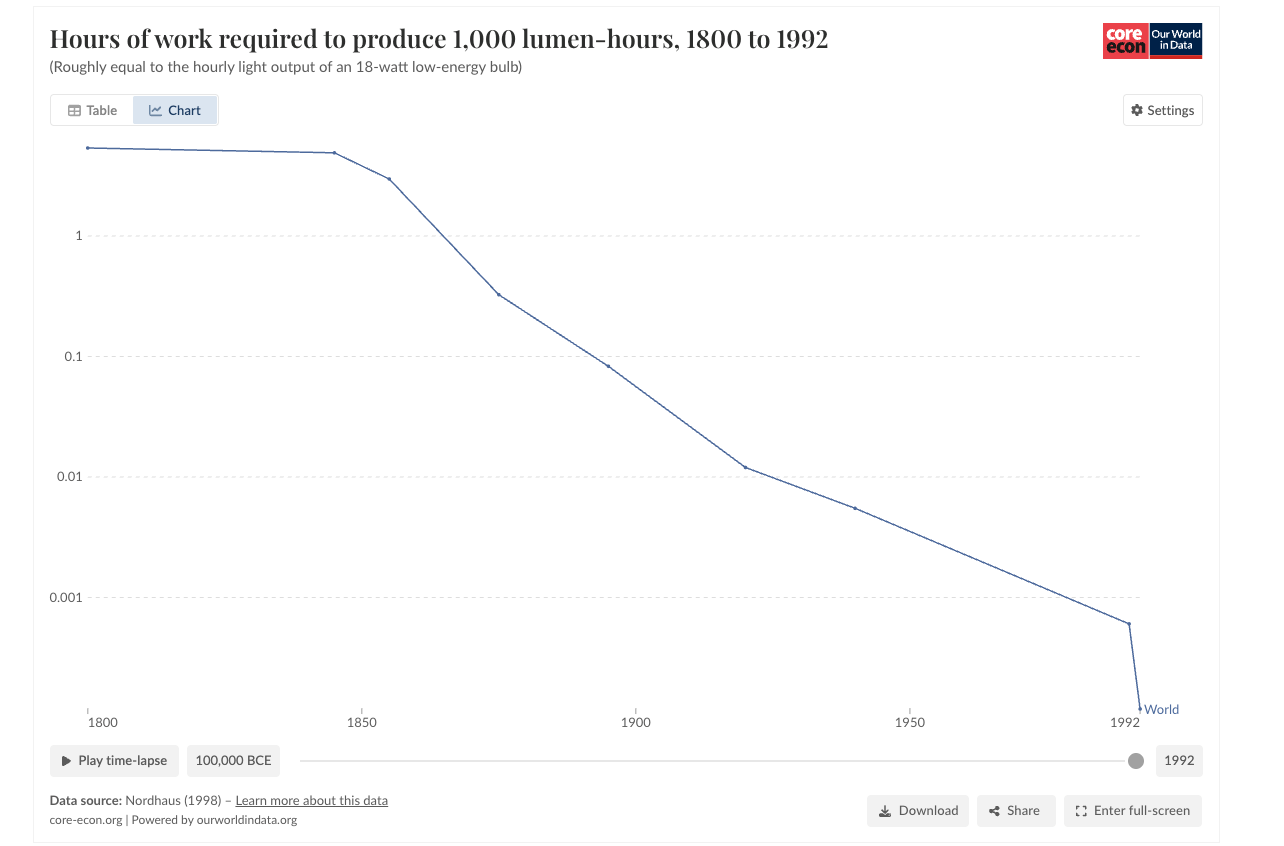
Democrats should support creative destruction as the engine of material progress. This contrasts with MAGA’s crony capitalism and the Democratic Socialists’ de-growth agenda. GDP is three letters, not four, and Democrats should unapologetically grow gross domestic product.
The policies on the creation side of the ledger are well understood. Delivery on them has been uneven, and getting worse. Improve education, particularly reading and math. Welcome legal immigration. Double science funding. Defend free speech and open debate. Protect intellectual property. Celebrate science and entrepreneurship. Contest monopoly and incumbent power. Cut cumbersome regulations. Expand markets with trade deals. Ensure a sound currency. Uphold the rule of law.
In aggregate, these policies midwife new ideas and give them a fair chance to get traction over time. It’s ideas that drive progress. It’s also ideas that generate disruption and dislocation.
This destruction side of the ledger has always been the painful part. The jobs that disappear. The places that decline. The people who feel left behind. In her excellent essay, Jerusalem Demsas argues that redistribution must be marbled into pro-growth policies. She writes:
“You have to redistribute as you grow. You have to make sure that people have a stake in the growth of their community, so that when they notice the irritations of construction on their commute or bristle at different languages being spoken at the coffee shop they frequent, they see that as part of an economic project that sustains their lives.”
The term stake, here, is the highlight. Not redistribution. I think people want ownership of their families’ slice of the future: the work, wages, and wealth. Money from working can be redistributed, but the dignity of work cannot.
The term stake also needs to be ennobled beyond the economic. In an interview this week with the New York Times, Pete Buttigieg says:
“The search for belonging [could produce a unifying narrative.] Perversely, it’s actually one of the main themes of Trumpism—except they are concerned with belonging from the perspective of who you can exclude. I think there’s a different way to think about belonging...
“I’m thinking about things like community, a certain concept of nation, and faith—but also a concept of nation and national service that could align well with progressive values, too. The power of the local, the meaning of knowing your neighbors and investing in that part of your life that is literally physically around you.”
Demsas and Buttigieg are pointing to the sense of a shared future. It requires the optimism of ownership and the security of belonging. I mean ownership literally: equity in the economy. Homeownership, baby bonds, employee stock ownership plans, entrepreneurship, simplifying public company governance, tax preferences for saving over consumption—Democrats should pursue ideas along many dimensions to give more Americans more stake in future growth.
People also want to belong in the here and now. Too often, Democrats define belonging ideologically: your politics is your tribe. Most Americans hate that. Most Americans define belonging through places and roles. ‘I’m from this town and I am a dad and I do this job.’ Efforts to strengthen this place-and-role-based sense of belonging are not primarily political, whether legacy institutions like churches, unions, and volunteer societies or new projects like Strong Towns, Rebuild Local News, and the First Person Project. Places and roles, more than red or blue, is how most people want to feel included.
Thank you for this breakdown. Belonging is hardwired into humans. I like how you separated money from worth. ❤️
Brilliant as ever. I so wish you could get a more extensive and broad-based national platform. You have an agenda for the future that most Americans, if communicated well, would buy into. We must indeed heal the divide in the country. Then we can begin to reform and rebuild, using much of the roadmaps you have outlined in Simple But Not Easy. Thank you for that.